Dr. Marie Enders presents a UniGR-Toolbox for valorizing encounters in the Greater Region
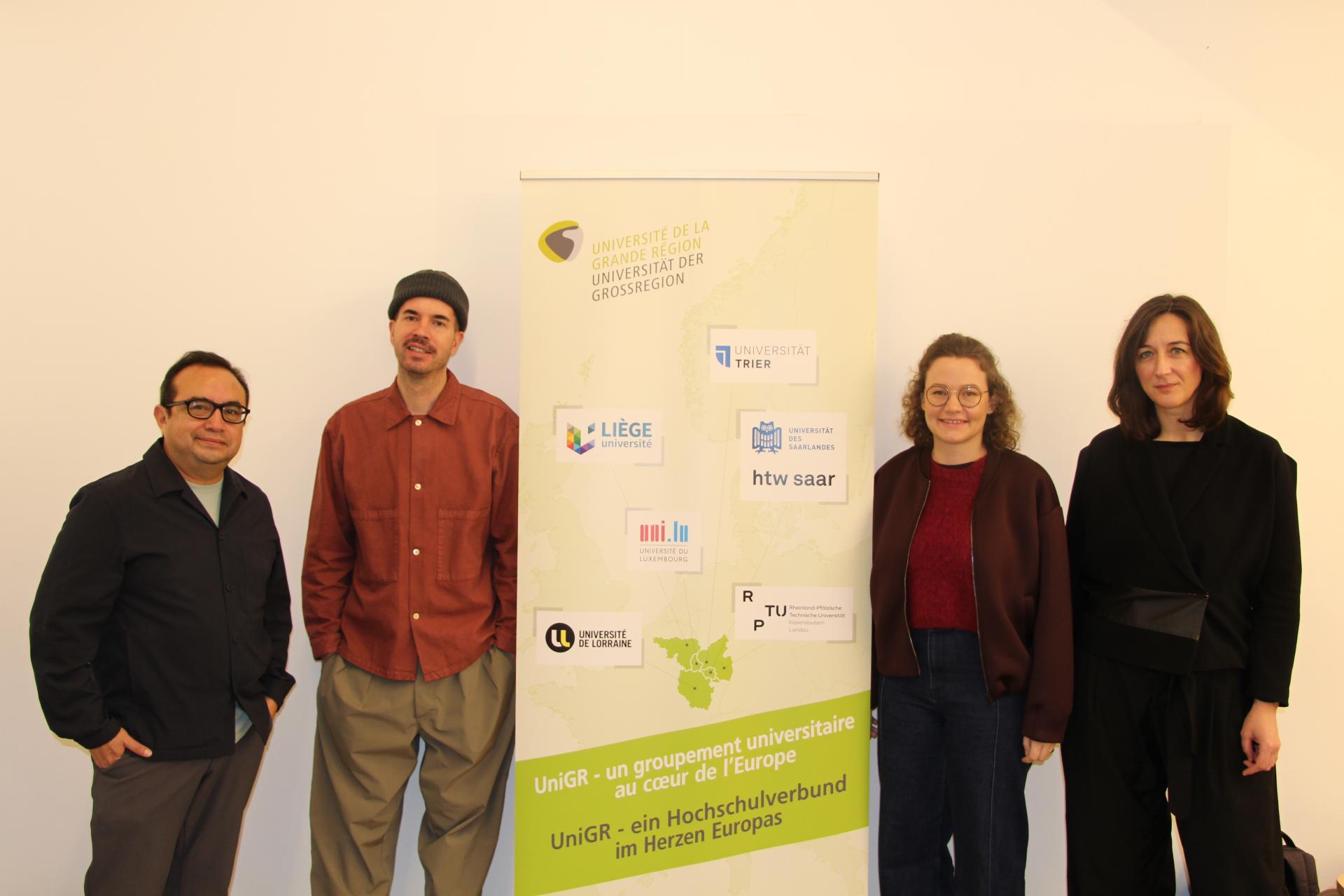
Within the framework of the UniGR Guest Professorship, Dr. Marie Enders conducted a research stay from October 2025 to January 2026 to explore how sites of encounter in the Greater Region can be identified, analyzed, and valorized using artistic-research tools. The project was based on the premise that democratic processes are inherently spatial and that everyday encounters constitute a fundamental, yet often underestimated, infrastructure of democratic practice.
The guest professorship was hosted by the Research Unit Cultures of Assembly (COA) at the University of Luxembourg, within the Department of Urban Renewal under Prof. Dr. Markus Miessen, and implemented in cooperation with the Department of Architecture – Theory – History (ATG) at RPTU Kaiserslautern-Landau, led by Prof. Dr. Adria Daraban, in collaboration with the Heimatinstitut. Funding was provided by the UniGR Mobility Scholarship, with additional support from the Fondation Marienburg, under the patronage of the Fondation de Luxembourg, and the Dean’s Office of the Faculty of Architecture (fatuk) at RPTU.
In a transnational tandem seminar, students from Luxembourg and Kaiserslautern worked together to identify and analyze sites of encounter.
The seminar began with a digital kick-off in October 2025, during which students received methodological inputs for tool development. Media artist Udo Noll presented his sound-mapping project, while game developers Sebastian Oberlin and Adrian Rennertz introduced the klang² collection. Building on this, students identified and analyzed encounter sites according to the four typologies of Rainald Manthe:
-
casual observation
-
recurring encounters
-
verbal exchange
-
shared activities
The first workshop in Esch-sur-Alzette in November 2025 deepened this work: students discussed their analyses in groups, developed cartographies, and tested initial playful formats. Students already reflected on early insights from the workshop:
“We realized that encounters in the Greater Region do not only connect places but also open up new perspectives (…) knowledge about the University of the Greater Region not only broadened our spatial horizon but also revealed opportunities to think about our studies within an international university network.” – Celina Philipps, Diploma student in Architecture at RPTU Kaiserslautern
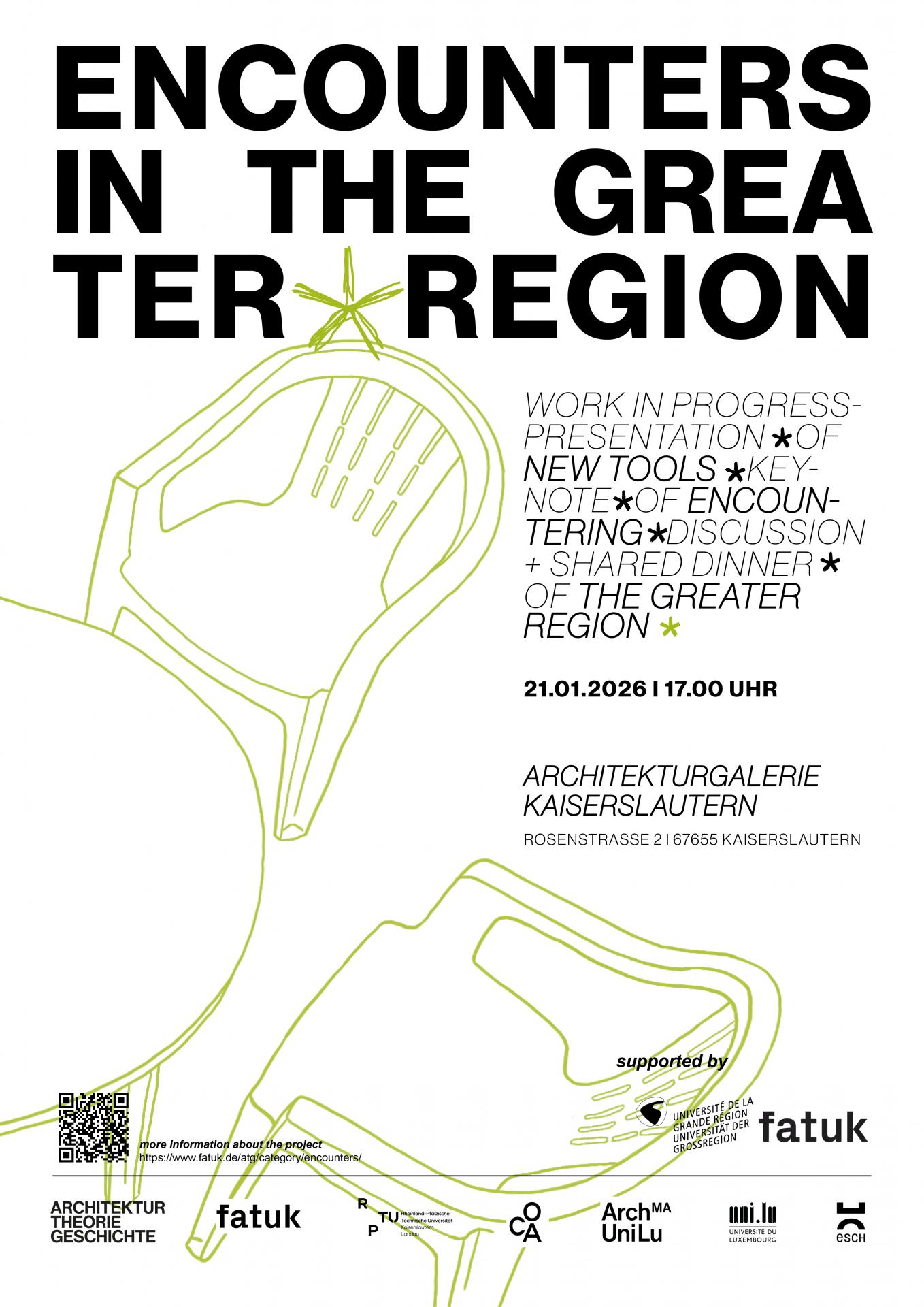
In the final phase, from 19 to 21 January 2026, the results were curated and publicly presented at the Architekturgalerie Kaiserslautern. The centerpiece of the presentation was the UniGR-Toolbox: eleven prototypes, each assigned to one of the analyzed encounter types, complemented by detailed guides on their conception, analysis, and implementation. Visitors were able to test the tools, play the sound-based memory game klang², and explore the wall-sized cartography of encounter sites.
The project enabled students to learn new artistic-research methods and experience transnational collaboration firsthand. The results are also relevant for the Greater Region, making encounters visible as a spatial resource for democratic engagement. Prof. Dr. Adria Daraban already highlighted potential follow-up projects:
"Vacant spaces in particular could be considered as ‘productive indeterminacy’ sites for the developed tools, opening up enormous potential.“
The collaboration between COA Luxembourg and ATG Kaiserslautern is planned to continue. The UniGR-Toolbox is set to be integrated into future teaching and research projects, supporting joint student work and the development of a digital version for the Greater Region. In the long term, it is envisioned that the toolbox—currently analog and to be digitized—will evolve within the UniGR context and be opened to other universities and institutions in the Greater Region. The tools are conceived not as finished products but as an open system that can be tested locally, developed regionally, and discussed across the Greater Region.
Finally, Dr. Enders highlights the special added value of the UniGR Guest Professorship:
"The UniGR Guest Professorship not only enabled the financial implementation of the project but above all opened a consistently cross-border perspective on the topic of ‘encounter’. Without the institutional framework of UniGR, neither the intensive collaboration between the two university locations nor the recurring student mobility would have been possible in this form. The transnational structure brought together different thematic, methodological, and cultural perspectives. For students, this created an expanded horizon: they not only learned new artistic-research methods but also experienced the concrete benefits of a Euregio university network—both in terms of content and possible study paths, collaborations, and mobility programs."
Further information about the project: https://www.fatuk.de/atg/category/encounters/